La capsula Informativa: frankly… Episode 84: Economic Growth Requires Education, Not Just Investment
The transcript below is AI-generated and may contain minor inaccuracies. Tune in to the episode audio to hear the full conversation!
Transcript
Dan
Hello, welcome to Frankly.
Rachel
Welcome back.
Dan
It’s been a little while here, yeah. It’s our longest break in three years. Yeah.
Rachel
You know what? We just needed a little breather. It’s all right. We’re back. We’re ready.
Dan
Yeah. So we are, we’re coming back with a good conversation, I think. Christine Roeder, who is vice president of Michigan Growth Advisors, which is a subsidiary of Miller Johnson, a law firm here in Michigan. And we get a chance to talk with Christine about a lot of things related to the world of economic development, kind of the importance of education around developments, whether that be housing, industrial or otherwise. And a little bit about kind of how the perception of Michigan and Detroit as a development destination has changed over these last couple of decades.
Rachel
Yeah, it’s a fun conversation. It’s, we sneak in some communications questions, of course, but from a regional standpoint, it really is an interesting conversation to be had. And she’s been in this economic development space for many, many years. And so how she’s seen it change, I think it’s interesting. She shares like her personal reasons for going into this space and kind of what fuels her still to this day to do the work that she does, which is a fun story.
Dan
Yeah. For sure. And a little bit, a little bit on mobility also kind of always, always sneaking something in there.
Rachel
Always sneak that in.
Dan
But I think, this is a great one to kick off the year and really start thinking about thinking about development in the city and the state and things to come.
Rachel
Yeah. Absolutely.
Dan
So we’ll kick off with Christine. Hi, Christine. Welcome to Frankly.
Christine
Hi, thank you so much for having me.
Dan
Yeah, thanks for coming on. We’re excited to talk with you. So we always like to kind of start out here by just getting a little bit about you. Talk to us a little bit about your kind of career path and what led you to where you are today with Michigan Growth Advisors.
Christine
Yeah, sure. So when I was in school, I had never heard of economic development. When I was in college, it wasn’t, there were no classes that were called that. There was no like, this is a career path. So it was really exciting for me when I finished my undergrad at MSU, Michigan State University. I had talked to some people about my desire to help communities that are dealing with plants that close and issues that come up with that. And that’s a personal story because my father worked at the Stoh’s Brewery in Detroit. And it closed when I was in middle school. And it forced… us to relocate to another, they moved us to another plant. So I lived in St. Paul, Minnesota for a few years until my dad retired. And then we moved back to Detroit where we have a large family and lots of friends. So that was really disruptive for my family. It was great that we were relocated and my dad wasn’t just out of a job. So I know it can be much worse. So I thought it was really cool when I found out that there are cities and states and counties that have people that literally work with companies to help them to navigate mergers and acquisitions or downturns to keep. keep plants open as much, as much as possible. So that’s kind of what got me interested in this work. My first couple of jobs were with city manager’s offices here in Metro Detroit for suburban communities. And then I worked for the Michigan Economic Development Corporation for over 20 years in their business development and retention and, you know, growth area. So worked with a lot of companies throughout Metro Detroit, mainly this is where I live. And then eventually over the 20 years was promoted into more senior level statewide kind of roles. So with that, I ended up working, when I left MEDC, I went to work for the Detroit Regional Partnership, where I was able to work under their federal grant, the Global Epicenter of Mobility. And I was really honored to be able to step into that role and kind of lead the coalition of, all the funded partners throughout the region in really lifting up mobility as something that we have that’s special here in the Detroit metro area. And it’s something that is truly the future and how we can leverage all the different supply chains and innovation and technologies to evolve the industry here. So I did that for close to three years, and then I landed here at Machine Growth Advisors just a few months ago. This was founded by a former colleague of mine at the MEDC. He founded it back in 2020 as an advisory economic development consultancy. And then back in 2022, it was basically Miller-Johnson Law, which has offices in Kalamazoo, Grand Rapids, and now here in Detroit. They were basically looking to acquire the work of Michigan Growth Advisors. And so now we’re a wholly owned subsidiary of the law firm. So it’s great. It’s a lot of fun so far, really working with all sorts of clients and helping them to navigate incentive applications, negotiate incentives, helping them with site selection, identifying opportunities for clients, and really helping companies and developers, you know, what makes sense for their projects here in Michigan and elsewhere.
Dan
Okay. And you’re focused primarily on kind of the east side of the state, is that right? Kind of taking what maybe was originally something west side and bringing it over towards Detroit.
Christine
Right, right. We’re a small group within the firm and we’re not lawyers. So we are truly, that’s why we’re a separate wholly owned subsidiary. But we’ve got three people in West Michigan between Kalamazoo and Grand Rapids, and then I’m here in Detroit. So it’s really exciting to be here in the Miller-Johnson Detroit office and to really help to bring the Michigan Growth Advisor work to clients here in Metro Detroit and save my colleagues from driving I-94 and I-96 to go. So yeah, there’s lots of opportunity here for Detroit.
Rachel
Well, and it’s a wholly owned subsidiary, but I have to imagine there’s some benefit backed by lawyers, right? When you’re talking about those negotiations and things like that, having lawyers in your back pocket is usually a big barrier for most people kind of in that space. It’s got to be helpful.
Christine
It’s great. And it’s actually, you know, one of the real benefits of doing work like this within a law firm. A lot of the clients are also clients of the law firm. And so this is an added benefit that they can offer their clients as well. If they have a client that’s looking at or weighing a decision on where to grow or where to add an office or a plant, and then they can bring us in to help with that advising. So it’s really great. And we’ve got projects not just here in Michigan, but outside of Michigan. And we’re really enjoying the work with using what’s available in the toolboxes across Michigan and other states to see what fits for the clients.
Dan
Yeah.
Rachel
If you can talk about it, what is like the most exciting thing that you think is coming, like, or that’s in the works? I would love to hear kind of what you think is exciting.
Christine
Yeah, well, I think a lot of people have heard about the affordable housing crisis, right?
Rachel
Yeah.
Christine
It’s nationwide. It’s not just, here in Metro Detroit, it’s everywhere. So the state legislature a couple years ago brought in the Brownfield, you know, the Brownfield Law that allows brownfields are, you know, basically. buildings or properties that are contaminated or obsolete, they’re able to use a tool to help them to clean it up and get it back into use. They’ve now applied that law to housing. So a lot of the work that we’re doing are with clients and developers that are going into communities and identifying opportunities to bring new housing. And then they’re using this incentive tool that is very unique to Michigan. And it’s seeing a lot of success in many, many communities across the state. So a lot of the work that I’ve been doing with the team here has been working with clients on educating and working with city councils and city managers across the state on this new tool, because it’s really new. So just figuring out how to use it.
Dan
Yeah, that’s really interesting. And you mentioned the education portion of that when it comes to like the cities or the municipalities, but like, how does, we’re a communications agency, so we always like to think in terms of that, but how does that kind of play into it at a larger scale, like talking to communities about developments or about these kind of like changes or opportunities? Like how important is that education outside of just maybe the city office, but just in the community at large too?
Christine
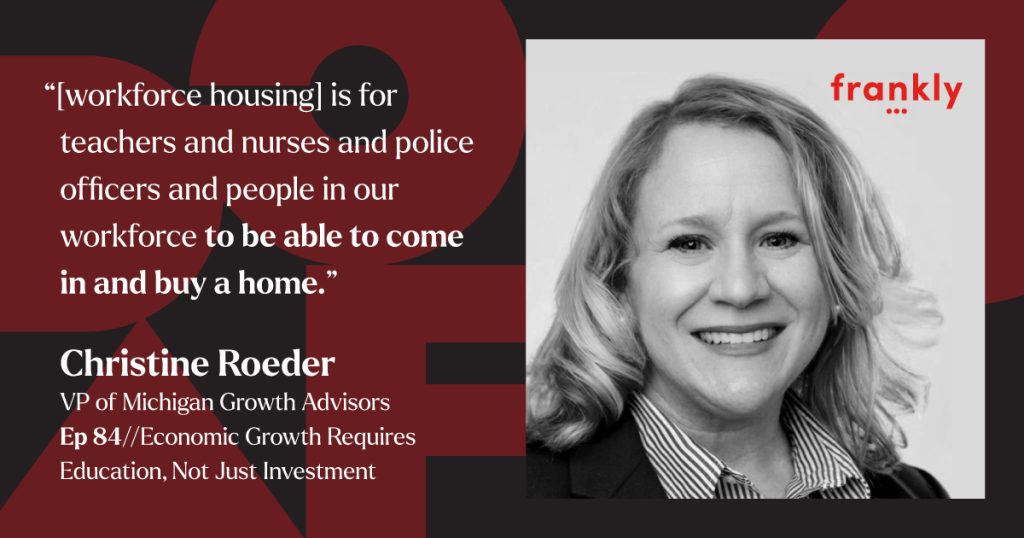
It’s so important. And I think that People take for granted that elected officials are fully aware of all the ways to use the laws in their state, county, or city, and ways to work with their business community or developers, ways to make their community more friendly if they want development in their community. So I think that education and communication on how these things are done, whether they learn it through, going to Michigan Municipal League conferences or they, listen to podcasts and hear about things, right? But the opportunity for us at Michigan Growth Advisors to work with our clients to get in early and talk with city managers or others that can then bring us to city councils or county commissions to talk about the benefit of these tools to be able to bring, in this case, workforce housing to their communities. And really, you know, this tool is really for communities to allow developers to come in and build a home that is not going to be $800,000 or $700,000. This is for teachers and nurses and police officers and people that our workforce, right, to be able to come in and buy a home.
Dan
Yeah, and I feel like a lot of times people will hear affordable housing and have something in their mind that maybe it’s not. You’re talking about those types of positions. Talk a little bit about maybe what that means for communities or what that looks like.
Christine
Right. again, that’s why, affordable housing, there’s also the missing middle, right? So you can go, you can get out of school, get out of college, or, get a job in the trades. You can find a first apartment, a first home, in a community generally. It’s that missing middle. It’s that, you know, you’re, maybe you’re going to have a couple kids. Maybe you want to plan for the future and get it something a little bigger, have a yard or whatever. These homes that are coming through this program across the state, it’s being used for single family homes or for four-bedroom homes, things that a lot of communities but aren’t able to offer in an affordable level for people. And affordable, again, is using income restrictions that are generally 80% to 120% of the average median income. So it’s not, we’re not talking about, you know, really low wages. We’re talking about, you know, people that are working in, you know, in jobs that are paying 80 to $100,000 a year, right? So, yeah.
Rachel
It’s affordable and how you define that has changed with how the economy has changed, right? I think that’s what people miss a lot of the times. And when you think affordable housing, even my parents back in the day to have two kids and a four bedroom house, like that was the norm. That was how people grew up. And now that, like you’re saying, it feels unattainable for people that even have very good, solid jobs in the economy that we’re in. It’s important to keep people, right? A lot of the goal of the places that you’ve worked and still work is to keep people in Michigan and keep people in this region to employ them. If they don’t have an affordable place to live, you’re going to lose good talent.
Christine
That’s what else we, when we’re talking with communities, we talk about the businesses they have in the community or those that are even nearby. If you’re in a more rural community where people drive further to get to work, you still want to have a place for people to land. And you still want to have people that have jobs and have good income to be able to come into your community. You’ve got companies that are, some companies are building their own workforce housing because they can’t rely on the market to provide it, right? So there are companies that are buying up old buildings or whatever and putting in apartments or the things that they can put employees in. So I think that this tool is quite revolutionary for the Michigan legislature to have kind of thought outside the box, broadened this law that’s been on the books for a couple of decades or more to allow it to be applied for housing. It’s a great tool and communities that we’re working with, it’s, really just identifying the development and then figuring out, how many units of that development will be held for affordable? Not the developers have to make money too, right? So They’re not doing this as a nonprofit, they’re doing this as for-profit companies. So it’s really just working with these clients and identifying the opportunities that are there and what communities are open to it. And those that may not be as open to it, how can we work with them to educate them and broaden their perspective related to it?
Dan
Yeah, that makes sense. So I wanna jump a little bit maybe to a different topic here and think about, looking back at your, your career, you’ve been working in Michigan, like you said, for a while now.
Christine
Long time.
Dan
I feel like there’s been some shift in how people think about the state, particularly Detroit, as a destination for development. How have you seen that kind of change over the years or, you know, has there been any major shift in whether it’s the type of businesses, the types of developments that you’re seeing or just quantity. What have you seen over those years in terms of that?
Christine
Yeah, I mean, it’s definitely in my time in this field, there’s been a shift. As you won’t be surprised to hear me say that this is just about the best it’s been, right? With not only the downtown, but also industrial investment. the investment in Corktown with Michigan Central, out by City Airport, you’ve got Flexing Gate and other, tier manufacturers in the automotive industry. So I feel as if the work that’s been done at the city level, partnering with the state and the county, frankly, on programs for workforce and training, and they’ve got, you know, Detroit at Work that really helps the city to work with companies that want to come to Detroit. And, whether you’re building a plant or putting in an office or whatever, they want to make sure that you’re hiring as many Detroiters as possible. So, companies are, it’s really a turnkey situation. You work with the city’s Detroit at Work program and they help to provide people that are ready to work and trained and, they’re ready to get in there. So I think that between the talent opportunities and just the way the city council and the mayor, and I’m, obviously Mayor Sheffield is brand new, but really hoping that everything still continues from the way that we saw things working when she was with the city council and her work with, development and economic development in particular. So really, I think it’s a great time. there, I have been here and, I’ve lived in Detroit or lived in the Detroit region most of my life. And I often think about that plant that my dad worked in, right? I remember going and, we, I just remember going to the plant and now I drive down Gratiot and I can drive by where it was. And so I always think about how different, not necessarily in my life, because my life has been, I’m not complaining about anything, but the other people that were working in that plant back in the 80s, and it wasn’t a great time for finding other jobs. It was a recession nationally, and then Detroit wasn’t as great. So I think about that, like if there were economic development initiatives at the state and local level to really help Stroh’s Hold that plant, open and maybe close the one and say, Oh, that my dad, but I’m just saying, like, there’s options, right?
Dan
Yeah.
Christine
And so, often I really do think about that long-term, like, back in the day, back in the 80s, Detroit lost a lot, and now… They’ve, the reinvestments in the plants, whether General Motors or Stellantis on the east side. And then you’ve got, again, Michigan Central. There’s just so much going on. It’s really a fantastic time.
Dan
Yeah, and it’s interesting to see, you know, you mentioned some of the other types of manufacturers or industrial stuff also, you know, it’s not maybe not just the auto industry. There’s still obviously a big, big footprint of that here in our kind of namesake of the Motor City, but there is a lot more, it seems. interest in maybe expanding or diversifying that. Have you seen other industry wise?
Christine
Yeah, sorry, Dan. Yeah, I was going to say diversifying within mobility, right? So, you know, yeah, we have single passenger vehicles that we’re really good at here in Michigan and in Detroit in particular. What about advanced air mobility, right? Drones and other delivery mechanisms. There’s maritime. We’re situated in the Great Lakes with access to the globe, right, from our shores here. We have the opportunity in aerospace and defense. We have a tremendous amount of defense companies and prime contractors to the federal government that are here in Metro Detroit and Southeast Michigan and supply chains with that. So there are just so many ways to diversify within this industry here with our talent and our legacy and the people that know this industry. It’s just really, there’s so much opportunity. And I think there’s a lot going on that you just don’t hear about.
Dan
Yeah, that’s a great point. So many of those skills are transferable, like between all of these groups. And you can see it like at Michigan Central or at NewLab, you can see kind of all of things coming together. It’s interesting to see what, how the definition of transportation for Detroit at least has changed over these last even decade.
Rachel
Yeah, I was, I think in your work with, you know, MEDC is obviously a little bit larger than mobility, but in your work with the Detroit Regional Partnership, what kind of nuggets did you pull out about mobility, right? So how we define mobility, I think when you’re in the space, you understand it’s all of those things, but within like the people within our region, I don’t know that everyone really thinks about it still, right? Everyone knows someone who works at a automaker or a tier one supplier, but what kind of education or communication around defining mobility and expanding that in this region did you do or would you think would be important to do around that topic?
Christine
The project that we were working on that’s still going, it’s still an active project that’s funded through the federal government. There’s 25 funded partners. that are part of that. And the definition, so 25 partners, and that goes from Detroit Regional Partnership, University of Michigan, Tech Town, Center for Creative Studies. Like there’s so many, you know, different organizations that are part of it. We defined it as anything, information that moves, people that moves, products that move, right? It was really just the movement of things. It’s not just a car or a bus or a truck. So when you have, you’re reaching out to startups and working with startups, you’re talking to talent, helping talent transfer their skills from doing one thing to the next thing, being more precise with something or less precise with something or whatever, right? So it’s just the shift of those skills. And then we had, we worked with legacy suppliers to the auto industry. We worked with hard tech, you hear a lot about software innovation, but there’s so much cool hard tech that’s going on at Lawrence Tech University at Centropolis. They are doing incredible work there. And our grant is just a little, our grant was just a little part of that. The talent work that’s going on with, whether it’s MichAuto or the Michigan Works Agencies throughout Southeast Michigan, really reaching out to those the people that are looking for their next step in their career or transitioning. So really defining it as far more broadly than, you know, you would have said mobility back a few years ago and people had a definite thought of what that meant or it’s physical mobility, like being able to run up and down the stairs or do the splits or something, right? So it’s, but this is, we’re talking about moving moving things, period. And it all applies. And again, Detroit and this region and Michigan are, really the global leader in this space. And it’s really important that we remember that and we get our swagger, right? And just own it like we should.
Dan
Okay, so one last kind of question for you. Just to kind of close things out, we always like to ask this kind of a general question. Looking back over your career, all that you’ve learned, all that you’ve kind of talked about today, what is something that you would have, what is a piece of advice you would have given to your 21-year-old self as you were coming out of college or just getting started?
Christine
Well, I think that it’s really important that people treat all, approach all people with the same level of interest and, curiosity. I think that relationships are so important as you go through your career. So if you can point back to relationships you’ve had for 25 years and people that, you know, you’ve moved on from a job or they have, but you still trust them, and they trust you, and you spent so much time developing those relationships, that’s really important. And it’s not just, oh, this is just work, and I’m just going to check this box, and I’m going to go to lunch with this person and whatever. No, those people can turn out to be incredible allies and friends and people that support you throughout your career, open other doors for you. I’ve gained so many friends through my professional, colleagues, as well as some of the companies that I called on or that I, that I worked with when I was at MEDC and knocking on doors in Oakland County. And, some of those people I still count as some of my closest friends that, they grew up in their companies and I grew up as well, but we’re still buddies. And so I think that just, You just never know what relationships are going to really be those that are going to last throughout your career. And just treat everyone the same and don’t assume that they’re this lower level person today or they’re not the CEO or whatever. You treat them all with respect and You just never know where you’re going to end up and that person could be the CEO one day or you could be the CEO one day, right?
Rachel
Yeah.
Christine
So I like to look at it. I like to think of that and I do. I don’t know, it’s how I’ve always approached things, but that’s, it’s something that, I learned early on. I had a really great city manager that I worked for right when I got out of school. And he taught me many lessons. And that was one of them was, you don’t, you know, not that I was walking in and treating like the front desk person as if they weren’t important, but just, he really drilled into me, like you run to make sure that no matter who it is, you’re interested, you’re paying attention. They’re the only person in the room. So that’s kind of what I followed. So yeah.
Rachel
You also don’t know who those people know, right? It’s like that connection of you have this circle. They also have a circle. It’s that what, like 6 series of separation. And that could either bite you down the road or be the thing that unlocks something else for you too, right? Like you don’t know who they have connection with.
Christine
Totally.
Rachel
So respect people and treat them all the same way because that’s what a good person does and it can help you. But also it’s like, you don’t know who they know on the other side. And the word travels.
Christine
Right. And again, like the work that I was doing at first was working with, you know, calling on really small companies and family owned companies and that just getting to know them like companies and people that run businesses, that’s their life. That’s what they want to do, right? So even if it wasn’t something that I was super interested in, whatever it might have been, I learned so much just by sitting with that owner or whoever it was and listening about the history of their company, what they were doing and their growth plans or how we could help them grow or whatever. So I just, I don’t know, it’s just, being curious, asking questions, being interested, treating people with respect. I think that’s advice that I received and learned and that I would also tell myself again, because it hasn’t let me down. So.
Dan
Yeah, and those like business owners, small businesses, they are such like a good reflection of the community. Like if you want to learn about the community that you’re working with, like who better than the people that are there talking with everyone every single day like that? It’s just, it’s so.
Christine
Totally. Right.
Dan
Yeah. Well, thank you so much for coming on today, Christine. It was great talking with you and really appreciate you taking the time.
Christine
Thank you for having me. This was a treat and a lot of fun, so I appreciate it.
Rachel
Thank you again to Christine. I can’t wait to see what her and Michigan Growth Advisors do this year. I feel like they’ve got a lot of awesome projects in the works that I’m excited to see through fruition.
Dan
Yeah, I really love that conversation. And yeah, I echo all that. Looking forward to seeing what’s in store for the coming years here.
Rachel
Absolutely.
Dan
So with that, thank you to everyone listening.
Rachel
Happy New Year.
Dan
Happy New Year. We’ll be back to regularly scheduled episodes and programming going forward here. So we’ll.
Rachel
Yes, we’ll see you then.