La capsula Informativa: When the Lights Go Out: What Spirit Airlines’ Shutdown Reveals About Crisis Communications in 2026
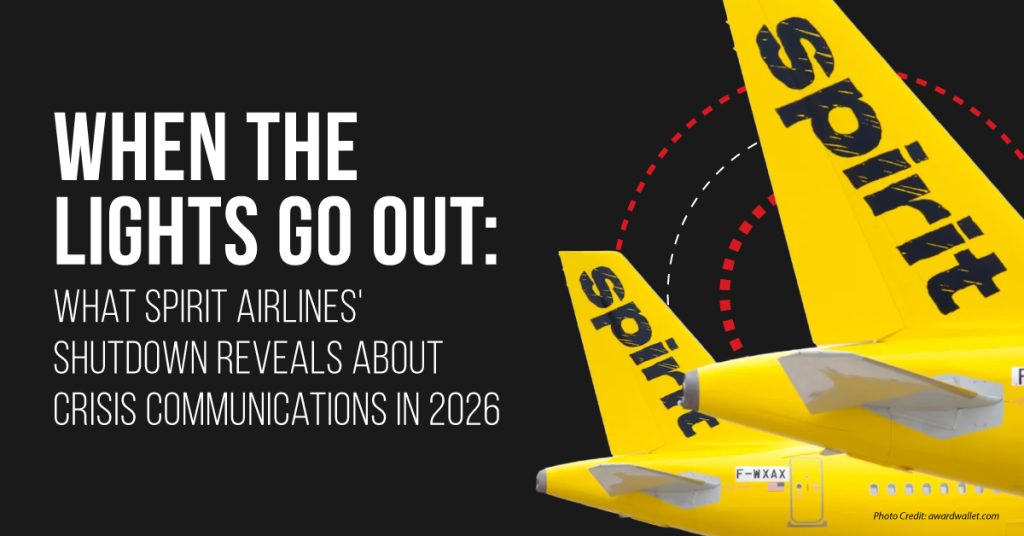
At 3 a.m. ET on May 2, 2026, Spirit Airlines posted a wind-down statement and stopped flying. Within an hour, roughly 17,000 people had lost their jobs, according to NBC News. Within 12 hours, JetBlue and Frontier were rolling out rescue fares. By the following Monday, a viral TikToker had crowdsourced more than $88 million in pledges to try to buy the airline. The shutdown itself was financial – a $500 million bailout fell apart, fuel prices spiked and bondholders said no. The collapse of the narrative, however, was a communications breakdown.
Based on The Wall Street Journal, Spirit became the first major U.S. airline in 25 years to go out of business because of financial problems. CEO Dave Davis said in a CNBC interview that the company “just kind of ran out of runway.” That’s a tidy metaphor for an aviation story. It’s also exactly the wrong tone for the moment Spirit was actually in.
Here’s where the communications strategy ran out of runway long before the airline’s planes did.
Long before the shutdown, Spirit was operating with a reputation challenge. As explored in a previous Franco blog post by my colleague Alexis Schuchert, the airline’s brand had already been navigating a delicate balance between cost leadership and consumer trust – a tension that shaped how audiences interpreted even its earliest bankruptcy communications.
For years, Spirit has been widely perceived as the “budget” or even “lesser” option among major carriers – a perception shaped more by its ultra-low-cost model, à la carte pricing and viral customer complaints than by safety or operational risk. That perception never aligned with its safety record. Commercial aviation in the U.S. is heavily regulated, and Spirit maintained a strong safety history, with no fatal crashes in its decades of operation according to PR Week.
That disconnect matters. When a brand is already framed as the “cheap” option, audiences are more likely to interpret a shutdown as inevitable failure rather than a complex financial collapse. Without proactive reputation management, Spirit entered its final hours with a narrative already stacked against it – one that made it easier for the public to dismiss rather than empathize.
Spirit’s announcement leaned on language like “orderly wind-down of operations” and “the sudden and sustained rise in fuel prices…left us with no alternative.” Accurate? Yes. Human? Not even close. Davis defended the abrupt timing by explaining the operational risks of a longer runway: “You can’t announce ahead of time that you’re going to shut down. What happens is vendors stop working. Fuelers stop fueling. Some crew members probably don’t come in.”
He’s right about the operational mechanics. But operational logic is not stakeholder communication. When a 34-year-old brand exits the market overnight, the first message should sound like it was written for the people who will read it – employees, passengers, partners – not for the bankruptcy court.
According to the Association of Flight Attendants-CWA, leadership’s message reached its 5,000 Spirit members at roughly 1 a.m. – not long before the public announcement. Benefits, seniority, travel privileges and health insurance all ended when the final flight landed in Dallas. As one flight attendant told WPEC, they were instructed to “order prescription drugs today because tomorrow you don’t have insurance.”
About 300 flight attendants in metro Detroit were among the 14,000 direct employees affected. When stakeholder communication boils down to a 1 a.m. union memo, the people you’ve worked alongside for decades end up writing the brand’s eulogy on their own. And they did.
Pilot Jason Smith on Instagram: “Here’s to 19+ years, lifelong friends made and the best job this guy ever had.” A Texas-based flight attendant’s emotional farewell speech aboard one of the final flights went viral on TikTok. Roxana Rodriguez’s Facebook post mourning a “second family” reached more people than any corporate release. The most authentic, emotional version of the Spirit story came from people who, hours earlier, had been told they’d lost their health insurance.
This is the social media reality we wrote about in a recent blog post on the McDonald’s CEO video: once content is public, audiences and employees co-author the narrative in real time. Spirit’s communications team didn’t lose control of the story. They never wrote it.
Spirit said it would automatically refund flights purchased with a credit or debit card and reported that most customers had been refunded. But cash-paying customers and travelers using loyalty points got nothing – the points couldn’t be transferred and weren’t honored. Loyalty points are the literal currency of brand affinity; declaring them worthless is a brand decision, not just a financial one.
Meanwhile, passengers were learning about the shutdown from cable news, social posts and competitors’ fare announcements before any direct communication from Spirit reached them. There were no proactive SMS alerts before they hit empty check-in counters. No multilingual gate updates for international travelers. No clear next-step guidance from the brand they’d just paid.
According to Bloomberg, JetBlue announced $99 rescue fares within hours, extended a jumpseat agreement so off-duty Spirit crew could get home and opened interview slots to displaced employees. Frontier, according to its own statement, offered up to 50% off base fares on more than 100 overlapping routes. United, Delta and Southwest capped fares around $200. The Department of Transportation rolled out its own relief plan. Inside a single news cycle, the dominant Spirit question shifted from “What is Spirit telling us?” to “What are Spirit’s competitors offering us?”
Based on JetBlue’s own announcement, the carrier is now expanding to 11 new cities out of Fort Lauderdale – Spirit’s largest hub – with daily departures up more than 75% from 2025. JetBlue and Frontier shares rose on the news. When a brand vacates the conversation, someone else writes the next chapter. Often, profitably.
Spirit’s collapse was caused by jet fuel costs and a failed bailout. The narrative collapse was caused by the absence of communications leadership at the moments it mattered most. In a crisis, the question isn’t whether you announce. It’s whether you’ve put your people, your customers and your brand reputation at the center of how you do it.
At Franco, we believe integrated communications is the strategy that holds when the room is on fire. Crises move fast. Empathy must move faster.